King of Kings
G. Connor Salter
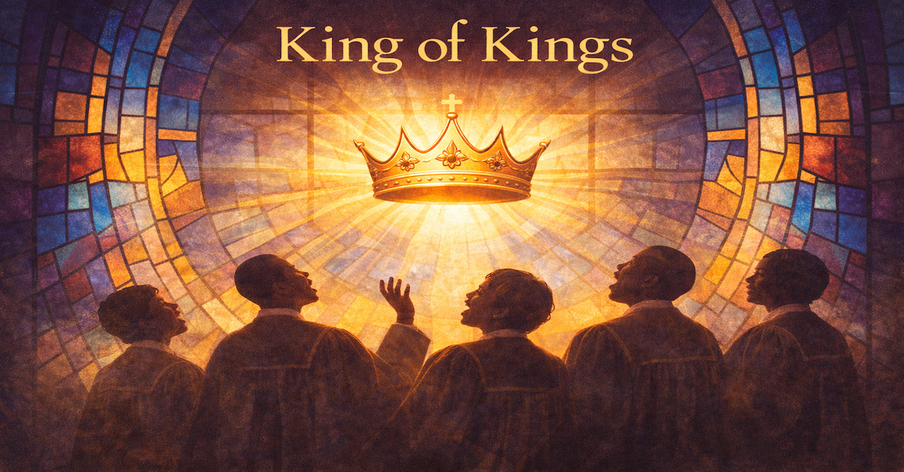
King of Kings Lyrics
He built his throne up in the air;
no one works like him;
and called his saints from everywhere;
no one works like him.
O he is King of kings;
he is Lord of lords,
Jesus Christ, the first and last,
no one works like him.
Chorus:
He is King of kings;
he is Lord of lords,
Jesus Christ, the first and last,
no one works like him.
O he is King of kings;
he is Lord of lords,
Jesus Christ, the first and last,
no one works like him.
He pitched his tents on Canaan ground;
no one works like him;
and broke oppressive kingdoms down;
no one works like him.
O he is King of kings;
he is Lord of lords,
Jesus Christ, the first and last,
no one works like him.
(Chorus)
I know that my Redeemer lives;
no one works like him;
and by his love sweet blessing gives;
no one works like him.
O he is King of kings;
he is Lord of lords,
Jesus Christ, the first and last,
no one works like him.
(Chorus)
The Story Behind King of Kings
“King of Kings” (sometimes also known as “He is King”) is one of many hymns first sung by African Americans in slavery, passed on orally from one plantation community to another over decades (perhaps centuries). Many of these songs are called spirituals, combining Bible references with references to pain (referencing the struggles of slavery) and to deliverance (referencing the freedom listeners craved from slavery), and sometimes veiled references to the Underground Railroad (a way that listeners could escape their slavery).
Because African American spirituals were developed long before current copyright law, and passed on over decades with church congregations trying out and changing lyrics depending on each crowd’s response, it is usually impossible to say who “wrote” the spirituals. It is easy to see Bible verses the spirituals reference. It is sometimes easy to find medieval hymns the spirituals borrow verses from. But it is rare to find one particular person who wrote the definitive version of a spiritual.
What historians can find out is who first collected a spiritual into a published book. Hymnary.org lists several key hymnals that published “King of Kings,” most famously a 1915 collection edited by John Wesley Work Jr. titled Folk Songs of the American Negro (“negro” was then a common term for African-American people). John Wesley Work Jr. (1871–1925), a teacher at Fisk University in Tennessee, worked with his brother, Frederick Jerome Work, to collect African American spirituals into books, making them among the first African-American scholars to collect many traditional songs into print. Other famous songs the Work brothers collected included such classics as “Go Tell It On the Mountain.”
More details about the song’s place in African American culture appear in books like Black Song: The Forge and the Flame: The Story of How the Afro-American Spiritual was Hammered Out by James Lovell Jr.
Scripture References in King of Kings
In Genesis, Canaan was where Abraham settled (pitching his tents as he moved his herds around the area), and became the land his descendants settled to establish the nation of Israel. While Abraham was a kingly figure (chieftain of a large estate that tended his flocks), God himself was Abraham’s king who had directed him to settle in Canaan. God also protected and blessed Abraham in Canaan many times over, assuring him that one day his children would be more numerous than the stars in the sky. Hence, the reference to “pitching a tent” could equally refer to God as well as to Abraham.
There are many verses that refer to God the Father or God the Son (Jesus) as being a divine king over all things. The verses that most closely fit the hymn are three New Testament verses calling Jesus the “king of kings.”
Paul ends his first letter to his disciple, Timothy, telling him to seek holiness, and “to keep this command without spot or blame until the appearing of our Lord Jesus Christ, which God will bring about in his own time—God, the blessed and only Ruler, the King of kings and Lord of lords, who alone is immortal and who lives in unapproachable light, whom no one has seen or can see. To him be honor and might forever. Amen” (1 Timothy 6:14-16, emphasis added).
Revelation features two descriptions of a holy king taking part in cosmic battles with evil forces. When the text describes one of the battles, it says that evil beings “will wage war against the Lamb, but the Lamb will triumph over them because he is Lord of lords and King of kings—and with him will be his called, chosen and faithful followers” (Revelation 17:14).
Two chapters later, the holy king rides into the final battle to vanquish evil once and for all:
“On his robe and on his thigh he has this name written: king of kings and lord of lords.” (Revelation 19:16)
Scripture Interpretations of King of Kings
“King of Kings” may not be a long song, but the lyrics offer some ideas which we discover are very powerful once we think about when the hymn was written.
As scholars like Juan M. Floyd-Thomas (Liberating Black Church) and James Anthony Noel (Preaching God’s Transformative Justice) have noted, the kingship theme in “King of Kings” presents an interesting balance between two beliefs African American Christians held to.
First, there was the belief in divine help and comfort. Remembering that Jesus was king, and a powerful one, was a refreshing thing to remember in dark times. It offered comfort, and its apocalyptic overtones conjured up a big picture view: there would be a day when goodness would prevail.
Second, there was the belief in challenging evil by remembering who the listeners really served. Many figures who owned slaves in America discouraged Sunday worship because songs and lessons about God being the king of kings was a subversive idea, a challenge to their authority. It was especially subversive because slave masters had an insidious level of control over people. Slavery was dehumanizing not only because slave owners claimed the right to own other human beings, but because so many people were specifically born to serve as slaves. By the time of the Civil War, the Atlantic salve trade was (officially) illegal, so many plantation owners had children with their workers to increase the population. Many Christians who sang “King of Kings” were given life by slave masters who “created” them to serve. Saying that God was king over all kings was a defiant reminder that God alone was the creator and sustainer of life. He is the one good master above all, including humans who claimed they could treat others as objects.
Singing about how Jesus is king over all kings reminded listeners of truth, and encouraged them to combat lies.
Much has changed today. But the hymn still reminds us to pursue holiness, combat sin, and hold onto the truth that there is only one God, one divine king above all false ones.
Popular Hymn Lyrics with Story and Meaning
Today's Devotional
A Prayer to Surrender Myself to God - Your Daily Prayer - March 6
We say we love Jesus, but have we truly given Him everything? Discover what it means to stop holding back and surrender your whole life to the One who gave His for you.
Top Artists


Top Music Videos

Chris Tomlin Chris Tomlin’s Powerful Live Rendition of ‘The First Hymn’ Will Stir Your Soul

Anne Wilson Anne Wilson Releases ‘Stars’ Music Video — An Uplifting and Encouraging Tune

toby mac TobyMac Drops ‘Heaven On My Mind’ Official Music Video

Chris Tomlin Chris Tomlin - Holy Forever

John Mark McMillan John Mark McMillan and Sarah McMillan - King Of My Heart


