Come Down, O Love Divine
Britt Mooney
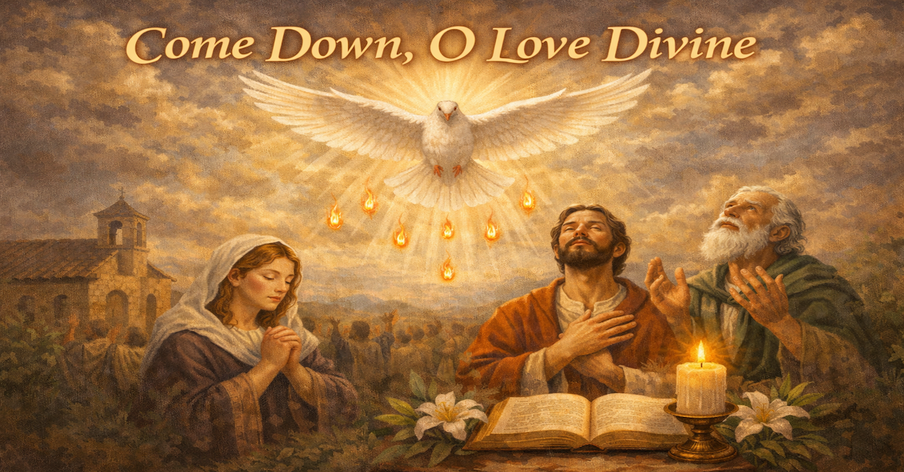
"Come Down, O Love Divine" Lyrics
Here are the lyrics to “Come Down, O Love Divine” in three verses:
Come down, O Love divine,
seek thou this soul of mine,
and visit it with thine own ardor glowing;
O Comforter, draw near,
within my heart appear,
and kindle it, thy holy flame bestowing.
O let it freely burn,
till earthly passions turn
to dust and ashes in its heat consuming;
and let thy glorious light
shine ever on my sight,
and clothe me round, the while my path illuming.
And so the yearning strong,
with which the soul will long,
shall far outpass the power of human telling;
for none can guess its grace,
till Love create a place
wherein the Holy Spirit makes a dwelling
The Story behind "Come Down, O Love Divine"
The partnership of “Come Down, O Love Divine” exemplifies the unity of believers across time.
The hymn originates with a 15th century Italian mystic named Bianco da Siena. Born around 1350 in Siena, Italy, Bianco lived during a time of spiritual revival within the Catholic Church. He belonged to a religious group known as the Jesuates, a lay order devoted to simplicity, devotion, and charity. Being a “layman,” Bianco wrote poetry in the common Italian language of his day, making his messages accessible to ordinary people rather than limiting it to the Latin-speaking clergy. Most people at that time no longer spoke the ancient Latin except in Mass or to read the Bible. His original poem was called, “Discendi, amor santo.”
Centuries later, the lyrics found new life among Protestants. Richard Frederick Littledale was born in Ireland in 1833, and served as a priest in the Anglican Church. He looked back and translated ancient and medieval writings of theology and hymns. As we can imagine, the “lay” mystic poetry from Bianco attracted the Protestant mindset, and Littledale translated Bianco’s text into English in 1867, making it accessible to his people.
He didn’t translate it literally, however, which is difficult to do in any language, although he maintained the ideas and message of the poem; he shaped and adjusted the poem into a form fit for the hymns of his day, much like modern worship songwriters take a psalm and reword things to make it fit a contemporary style.
Still, the English version didn’t become the hymn we know until the early 1900s when people placed it with a common tune called “Down Ampney,” composed by Ralph Vaughan Williams. Williams was a very influential composer and had a passion for English hymns and folk music. His tune gave the text a simpler yet reverent musical setting. The hymn then became popular and began to be included in hymnals.
These three men combined across centuries to produce an inspiring hymn, a work of God through time and art and attempts to express his love to the people of their day. Bianca da Siena’s mystical poem, Littledale’s English translation, and Williams’s composition all met to bring a new song to the church.
What Inspired "Come Down, O Love Divine"?
Bianco da Siena lived and thrived in a community that longed for a more personal, experiential faith. In the 14th century, the Catholic Church dominated the religious landscape in Europe, and they taught and spoke in Latin (not understood by most people) and tried to limit doctrine to the priests. As happens during any spiritual revival, God’s presence spreads and expresses himself among all people, regardless of education or position. Bianco and his community sought and talked about their direct encounters with God, the loving Savior meeting with people, heaven coming to earth in Christ.
These mystical ideas were easily found in Scripture, especially passages describing God’s love as indwelling and active. The themes of “Discendi, amor santo” come from verses like Romans 5:5, where God’s love pours into hearts through the Holy Spirit, and Acts 2, where the Spirit appears as fire. These images infuse and guide the hymn’s main metaphor. Divine love is a heavenly flame that fills the believer, strengthens, and purifies. Bianco didn’t see God’s love as a simple emotion but as God’s actual presence filling the human heart and setting it aflame with his holiness.
The late medieval church experienced movements calling people to repentance, humility, and deeper devotion to God alone. We could even see the Protestant Reformation in this light. Bianco remained within the Catholic tradition and wrote poetry with these messages. As “mystics” have done across time, Bianco wrote how human effort can’t produce a spiritual life. Instead, God must initiate the transformation. Hence, this is why the hymn begins with the plea for God’s love to come down to change hearts, our own and others.
When Richard Frederick Littledale translated this poem, he preserved the same message, calling us not to simply seek knowledge about God but to seek a real, life-changing experience of his love to reshape our hearts, and by extension, our actions and words.
“Come Down, O Love Divine” in Worship
After Williams’s melody combined with Littledale’s English translation in the early 20th century, churches across England and further started using the hymn in regular worship. Its imagery, theology, and language made it a meaningful song for reflective moments in services, times when believers sought to experience God’s presence deeply.
In the earlier 1900s, many congregations sang the hymn during seasons like Pentecost. The lyrics of God’s love entering hearts and producing divine change connects well with celebrating when the Church received the Holy Spirit in Acts 2. The hymn includes pictures of divine fire and indwelling love, useful for inspiring spiritual awakening and empowerment. Churches would also employ it during times of confession or dedication, inviting worshippers to examine their hearts.
Since Bianco wrote the original poem during a revival of sorts, the church generally used the hymn to break congregations out of complacency and spiritual ruts. As such, as hymnals started being used in most churches across America, England, and other places, the song found a home in both Protestant and Catholic traditions, a type of unifying bridge between liturgical and evangelical contexts.
In modern times, liturgical Protestant and Catholic congregations continue to sing this hymn with a classic organ, piano, or even as a special by the choir. More blended services might adapt it with contemporary arrangements on the guitar. Modern worship leaders choose it for renewing consecration and devotion, possibly adding a refrain as is common in contemporary settings.
Lessons on God’s Love from “Come Down, O Love Divine”
God’s love isn’t distant. He so loved the world that he came to be one of us, to live among us. He sent his Son so that we could be saved from destruction and enjoy eternal life. God’s love seeks us out, actively comes to us. His love fills and transforms us.
From the opening line, “Come Down, O Love Divine” reveals how love comes from God, not us. God is love, and his love rules the perfect, divine order. Heaven comes to earth because of God’s love. Our effort can’t accomplish living the spiritual life we long for. God must initiate it. He loved us first.
Next, the hymn shows that God’s love dwells within us. He does not stay distant or external. His love isn’t theoretical or academic. The hymn repeatedly talks about his indwelling love in our hearts, reflecting the biblical teaching on how the Holy Spirit lives within those who repent and follow Christ as Lord. The Father’s love becomes a present and ongoing reality. When we receive this revelation, it shapes our hearts, thoughts, desires, actions. We are transformed from the inside out by God and his love.
Further, the hymn describes love as a purifying, holy flame, one that burns away sin and refines us. While not popular among modern culture, this image aligns with scriptural portrayals of God as a refining fire. We need God’s work to forgive and cleanse and take away our sinful and selfish nature. God’s love does comfort, but he also corrects from the ways of death to the way of life. God’s love exposes what is broken and restores what is good. We should welcome that process rather than feel God’s correction is hateful or evil. God’s love always sacrifices the temporary for the eternal.
Once connected and committed by love, filled with overwhelming goodness, and purified from the things which lead us astray, God’s love leads us to obedience. God’s love within us will produce overflow into loving action surrendered to God as Lord. The lyrics of the poem and hymn call us to humility and reverence. Our obedience doesn’t come from obligation or religious duty but from his love for us and ours for him. This produces a life of worship.
Lastly, God’s love sustains us. We often feel weak and unable to continue, but remembering his love and mercy guides us, calls us forward. We depend on God for salvation, yes, and also for every moment we live, for daily strength and perseverance. We don’t endure life’s hardships from duty or our will but due to God’s love calling us to hope and a good future.
It’s fascinating how a hymn produced across Catholic and Protestant traditions, across 600 years, expresses such a truth. God loved us extravagantly, sought us out, brought heaven to earth, dwells in our hearts, changes and refines us, and keeps us going until the end.
Peace.
Popular Hymn Lyrics with Story and Meaning
Day by Day and With Each Passing Moment
Jesus Loves Me
What a Friend We Have in Jesus
Blessed Assurance
Nearer My God to Thee
Abide with Me
His Eye Is On the Sparrow
Be Thou My Vision
Holy, Holy, Holy Lord God Almighty
Amazing Grace
And more!
Today's Devotional
A Prayer for Resurrection in the Areas I Thought Were Dead - Your Daily Prayer - April 2
Just as Jesus rose from the grave, God can breathe life into the areas of our lives that feel buried. No matter how devastating the loss, when we seek Him in our disappointment and pain, we will begin to see dry bones stir.
Top Artists


Top Music Videos

Chris Tomlin Chris Tomlin’s Powerful Live Rendition of ‘The First Hymn’ Will Stir Your Soul

toby mac TobyMac Drops ‘Heaven On My Mind’ Official Music Video

John Mark McMillan John Mark McMillan and Sarah McMillan - King Of My Heart

Casting Crowns 'Glorious Day (Living He Loved Me)' Casting Crowns Live

Chris Tomlin Chris Tomlin - Holy Forever


