O Love That Will Not Let Me Go
G. Connor Salter
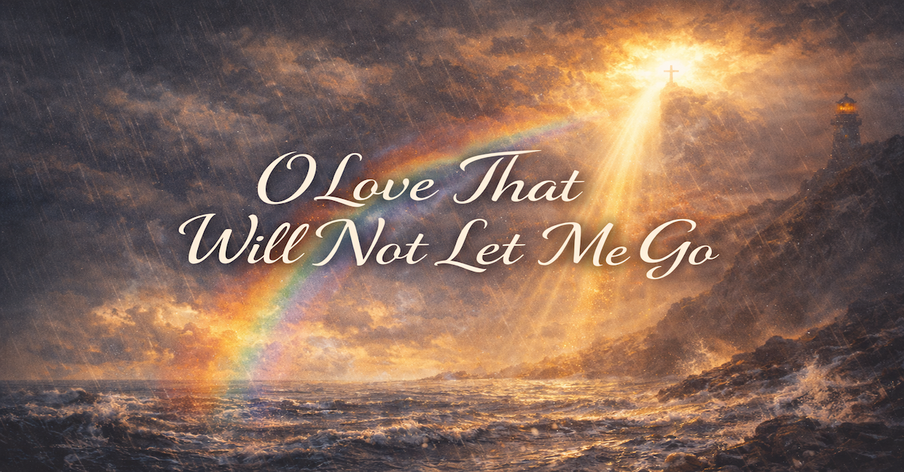
O Love That Will Not Let Me Go Lyrics
O love that will not let me go,
I rest my weary soul in thee;
I give thee back the life I owe,
That in thine ocean depths its flow
May richer, fuller be.
O Light that follows all my way,
I yield my flick’ring torch to thee;
My heart restores its borrowed ray,
That in thy sunshine’s blaze its day
May brighter, fairer be.
O Joy that seekest me thru’ pain,
I cannot close my heart to thee;
I trace the rainbow thru’ the rain
And feel the promise is not vain
That morn shall tearless be.
O cross that liftest up my head,
I dare not ask to fly from thee;
I lay in dust life’s glory dead,
And from the ground there blossoms red
Life that shall endless be.
The Story Behind "O Love That Will Not Let Me Go"
According to John Crew Tyler and Michael C. Hawn, George O. Matheson (1842–1906) was a Scottish academic who lived in Edinburgh and Inellan, known as “the blind poet-preacher.” Matheson was diagnosed with an incurable visual impairment when he was 17, but persisted in his academic studies and became a highly respected minister, even receiving preaching invitations from Queen Victoria and participating in the acclaimed Baird and St. Giles lectures.
Matheson wrote “O Love that Will Not Let Me Go” on June 6, 1882, while living in Inellan, “in a moment of pure inspiration” one summer night. According to biographer Donald MacMillan, Matheson’s sister was getting married the next day, but Matheson was struggling to feel happy for his family because of “the most severe mental suffering.” Matheson did not offer more details, but many historians report that he had been engaged years earlier and his fiancée left him after his medical diagnosis, not wanting to live with someone who would eventually go blind.
Matheson recalled that the song was “the fruit of” his severe suffering, but felt like it was “dictated by some inward voice” and was written very quickly. “I am quite sure that the whole work was completed in five minutes, and equally sure it never received at my hands any retouching or correction.”
“O Love that Will Not Let Me Go” was published in 1882 in Life and Work, a religious magazine managed by the Church of Scotland. In 1884, it was set to the tune “St. Margaret” by Dr. Albert Lister Peace and printed in The Scottish Hymnal. A few years later, Matheson included it in a collection of his hymns, Sacred Songs.
Matheson wrote that “O Love That Will Not Let Me Go” was perhaps his best hymn because “all the other verses I have ever written are manufactured articles; this came like a dayspring from on high.” Over a century later, the song continues to be Matheson’s best-known work.
Scripture References in "O Love That Will Not Let Me Go"
Because the hymn is brief and mentions many images that appear throughout the Bible, it is difficult to name specific Bible references that match the song. However, we can identify the key things or images the hymn uses.
Tracing the rainbow through the rain evokes seeing something beautiful in the midst of a sad event, but also hearkens to an early biblical image of hope. Genesis 9:13-17 describes God setting a rainbow in the sky when Noah and his family exit the ark safely, a sign of his promise not to cause another worldwide flood. The promise is a covenant (a binding agreement) between God and Noah. The rainbow is therefore a sign of how God promises to bring healing after pain, and can be trusted to uphold his promises.
Resting one’s soul in God by trusting him aligns with verses like Jeremiah 31:3 (often printed alongside the song in hymnals), about resting in God’s love and trusting in him.
The reference to the cross “that liftest up my head” that the songwriter will not run away from combines images about looking to the cross as the model for how Christians should act (Hebrews 12:2), and perhaps also commands to imitate Christ by “taking up our cross” and following him (Luke 9:23). The cross is both an image that humbles Christians, reminding us of Jesus’ sacrifice, and also a call to take up our own cross for Christ.
The final image of the song, of blood falling but bringing new life on the ground, affirms that when we surrender to Christ, we die to ourselves but find new life. This principle is communicated in many verses about salvation, such as Jesus telling his audience that they can only save their lives by dying to themselves, that “unless a kernel of wheat falls to the ground and dies, it remains only a single seed” (John 12:24).
Matheson understood the principle of giving things up in a particularly poignant way. Dreams of being married and having a family died. Hopes of staying perfectly healthy during his adult life went unmet. Yet as he submitted his suffering to God, he found that there was freedom and joy in Christ’s love that made up for all he lost.
Popular Hymn Lyrics with Story and Meaning
Day by Day and With Each Passing Moment
When the Saints Go Marching In
Jesus Loves Me
King of Kings
What a Friend We Have in Jesus
Blessed Assurance
Nearer My God to Thee
Abide with Me
His Eye Is On the Sparrow
Be Thou My Vision
Holy, Holy, Holy Lord God Almighty
Amazing Grace
And more!
Playlist of Performances of "O Love That Will Not Let Me Go"
Today's Devotional
A Prayer to Surrender Myself to God - Your Daily Prayer - March 6
We say we love Jesus, but have we truly given Him everything? Discover what it means to stop holding back and surrender your whole life to the One who gave His for you.
Top Artists


Top Music Videos

Chris Tomlin Chris Tomlin’s Powerful Live Rendition of ‘The First Hymn’ Will Stir Your Soul

Anne Wilson Anne Wilson Releases ‘Stars’ Music Video — An Uplifting and Encouraging Tune

toby mac TobyMac Drops ‘Heaven On My Mind’ Official Music Video

Chris Tomlin Chris Tomlin - Holy Forever

John Mark McMillan John Mark McMillan and Sarah McMillan - King Of My Heart


