Jerusalem (hymn)
S. E. Tschritter
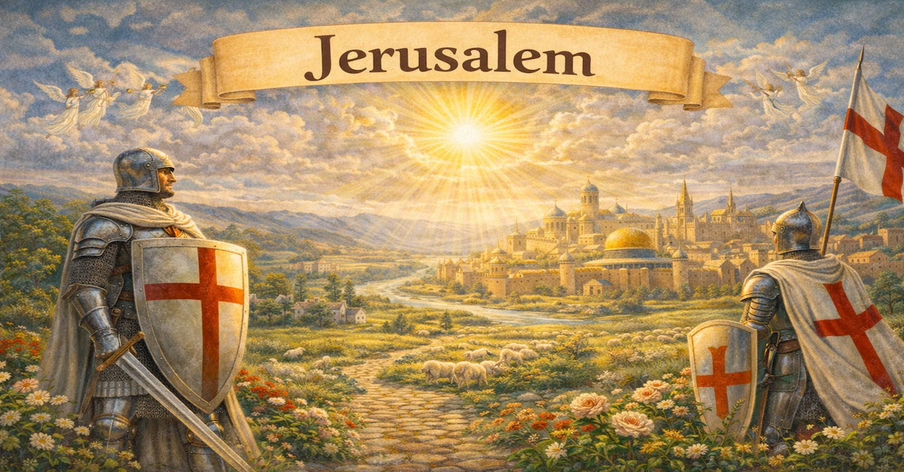
"Jerusalem Hymn" Lyrics
And did those feet in ancient time
Walk upon England's mountains green?
And was the holy Lamb of God
On England's pleasant pastures seen?
And did the Countenance Divine
Shine forth upon our clouded hills?
And was Jerusalem builded here
Among these dark Satanic mills?
Bring me my bow of burning gold
Bring me my arrows of desire
Bring me my spear, O clouds unfold!
Bring me my chariot of fire.
I will not cease from mental fight
Nor shall my sword sleep in my hand
Till we have built Jerusalem
In England's green and pleasant land.
The Story behind "Jerusalem Hymn"
“And did those feet in ancient time walk upon England's mountains green?
And was the holy Lamb of God on England's pleasant pastures seen?
And did the Countenance Divine shine forth upon our clouded hills?
And was Jerusalem builded here among these dark Satanic mills?”
These first two stanzas allude to the English myth that Jesus and Joseph of Arimathea traveled to England. However, these lines might also express Blake’s longing for an intimacy with a God.
Battle Imagery in the Hymn
When I cross-referenced the images of “bow of burning gold,” and “arrows of desire” with the Bible, my findings confused me. In Scripture, each of these phrases suggests a negative connotation.
Many writers and bloggers suggest that these phrases portray the metaphorical fight against “a new economical system that ruined the landscape, polluted the air and the waters and treated people as mere cheap labour, including women and children.”
I believe Blake would agree with their conclusion.
Historical context, though, is also key. Blake lived during the time of the French Revolution—and supported the cause. The revolution was born out of harsh treatment and taxation on the lower classes. The revolution succeeded in abolishing both the monarchy and slavery in France.
Therefore, Blake’s declaration that he will raise his bow of burning gold suggests a will and desire to fight against oppression.
Yet, the Biblical imagery still nags at me.
Blake was a zealous Christ-follower and avid studier of Scripture. He knew Hebrew and often quoted the Bible in regard to his own works. It’s not a far leap, then, to conclude Blake would have been familiar with popular passages of Scripture such as “the armor of God.”
Ephesians 6:16 says: “In addition to all this, take up the shield of faith, with which you can extinguish all the flaming arrows of the evil one. Take the helmet of salvation and the sword of the Spirit, which is the word of God.”
Note the contrast. The apostle Paul, in his letter to the Ephesians, implores Christians to raise a shield of faith against “the flaming arrows of the evil one.” Flaming arrows are the weapon of the enemy.
And,
Psalm 64:1-3
Hear me, my God, as I voice my complaint;
protect my life from the threat of the enemy.
Hide me from the conspiracy of the wicked,
from the plots of evildoers.
They sharpen their tongues like swords
and aim cruel words like deadly arrows.
Here again, King David describes evil men aiming cruel words like arrows. So, why then would William Blake compare himself to “the evil one” or David’s enemies? A theory emerged, and I reread the second stanza with a sarcastic tone. Then I researched, “Was William Blake a controversial figure of his time?”
The answer? Highly. Religiously and politically, he cheered for the underdog and against an unsettling climate of arrogance and injustice that contradicted God’s admonishment for justice and mercy.
I can almost hear the conservative religious scholars of his day weaponizing the Bible and using various phrases against him to describe Blake’s eccentric art and outcries against the establishment. Watch out for that traitor, Blake, who notches the Evil One’s arrows for him.
The causes Blake championed were no secret and, at one point, Blake was even arrested for treasonous statements against the king. This is pure speculation, but what if these verses were Blake sarcastically owning his label as a rebel, owning the fight? What if his words echoed Jesus’s own rebellious words against the political and religious establishment?
Matthew 23:23-24: “Woe to you, teachers of the law and Pharisees, you hypocrites! You give a tenth of your spices—mint, dill and cumin. But you have neglected the more important matters of the law—justice, mercy and faithfulness. You should have practiced the latter, without neglecting the former. You blind guides! You strain out a gnat but swallow a camel.
Bring me my bow of burning gold. Bring me my arrows of desire.
I wish I could ask Blake if the above stanza was verbatim words used against him. The very next sentence depicts his weariness with the futility of it all. From fight to flight, “Bring me my spear, O clouds unfold! Bring me my chariot of fire” references the moment Elijah is taken into heaven (2 Kings 21-14).
I will not cease from mental fight. Nor shall my sword sleep in my hand.
Jump back to Ephesians 6:17.
"Take the helmet of salvation and the sword of the Spirit, which is the word of God.”
Here in this passage, the sword describes the Word of God and Blake promises to wield the sword until “we have built Jerusalem in England's green and pleasant land.”
In his way, William Blake did just that. Blake spent his life imitating the heart of Christ to the best of his ability. He championed the caused for those who did not have the education, position, or power to speak for themselves.
William Blake died on August 12, 1827. George Richmond, a friend present at the time of his death, wrote, “He died ... in a most glorious manner. He said He was going to that Country he had all His life wished to see & expressed Himself Happy, hoping for Salvation through Jesus Christ – Just before he died His Countenance became fair. His eyes Brighten'd and he burst out Singing of the things he saw in Heaven.”
Sometimes the pen is mightier than the sword.
Interestingly enough, Edward Bulwer-Lytton, who coined that phrase, was a noble, author, and politician who lived in London at the same time as Blake.
True,—This!
Beneath the rule of men entirely great
The pen is mightier than the sword. Behold
The arch-enchanters wand!— itself a nothing!—
But taking sorcery from the master-hand
To paralyse the Caesars—and to strike
The loud earth breathless!—Take away the sword—
States can be saved without it!
-Lytton
Additional Resources
https://www.classical-music.com/articles/jerusalem-lyrics
https://multimedia-english.com/print/preview/jerusalem-poem-by-william-blake-2424
Popular Hymn Lyrics with Story and Meaning
Day by Day and With Each Passing Moment
Jesus Loves Me
What a Friend We Have in Jesus
Blessed Assurance
Nearer My God to Thee
Abide with Me
His Eye Is On the Sparrow
Be Thou My Vision
Holy, Holy, Holy Lord God Almighty
Amazing Grace
And more!
Today's Devotional
A Prayer to Stand Firm When Everything Feels Unstable - Your Daily Prayer - March 16
When the future feels terrifying, and the ground won’t stop shaking, how do you keep standing? This powerful prayer will help you look back at God’s faithfulness and find the strength to face what’s ahead.
Top Artists


Top Music Videos
Chris Tomlin Chris Tomlin’s Powerful Live Rendition of ‘The First Hymn’ Will Stir Your Soul

Chris Tomlin Chris Tomlin - Holy Forever

Anne Wilson Anne Wilson's Powerful ‘God Story’ Official Music Video
Chris Tomlin Chris Tomlin ‘Still The King’ Lyric Video
Universal Music Group Pat Barrett Official Video for ‘Hard Part of a Dream’


