All People That on Earth Do Dwell
Britt Mooney
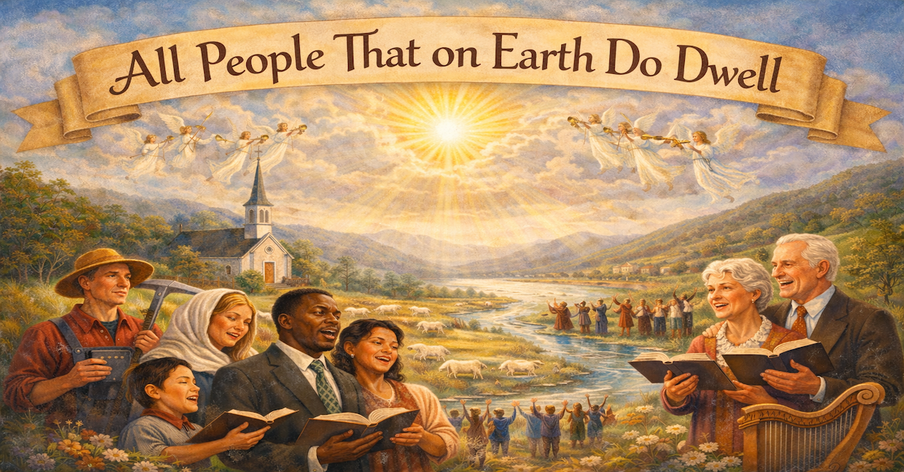
"All People That on Earth Do Dwell" Lyrics
Here are the lyrics for the hymn in four main verses.
All people that on earth do dwell,
Sing to the Lord with cheerful voice;
Him serve with fear, His praise forth-tell,
Come ye before Him and rejoice.
Know that the Lord is God indeed:
Without our aid He did us make;
We are His folk, He doth us feed,
And for His sheep He doth us take.
O enter then His gates with praise,
Approach with joy His courts unto;
Praise, laud and Bless His Name always,
For it is seemly so to do.
Oh know the Lord our God is good,
His mercy is forever sure;
His truth at all times firmly stood,
And shall from age to age endure.
Praise God from Whom All blessings flow; Praise Him, all creatures here below; Praise Him above ye heavenly host; Praise Father, Son, and Holy Ghost.
The Story behind "All People That on Earth Do Dwell"
The hymn comes from two important leaders of the Protestant Reformation. William Kethe wrote the English lyrics, and Louis Bourgeois composed the music. The Protestant break from Catholicism included new songs and music. Both men influenced the congregational singing of the Reformed movement during the 1500s.
William Kethe was a British Protestant clergyman and hymn writer, and he lived during the revolutionary years of the Reformation. He probably fled England during the reign of Catholic Queen Mary I and joined some Protestant exiles in Geneva, Switzerland.
In Geneva, several English reformers collaborated to produce new versions of the biblical Psalms so ordinary believers could sing Scripture in worship. Kethe wrote the words of “All People that on Earth Do Dwell” as a metrical paraphrase of Psalm 100. Kethe’s text calls people to worship God with joy and thanksgiving, from the themes of Psalm 100.
In those days, common folk or congregational melodies would be used and hymn writers would place new words to it, the music being familiar to the congregation. The one most commonly used for this song is known as the Old Hundredth, originally composed by Louis Bourgeois, a French musician who worked in Geneva during the Reformation, as well. Bourgeois edited and composed music for the Genevan Psalter, trying to provide simple melodies for the congregation to sing. Bourgeois originally wrote the melody for a French version of Psalm 134, but English worshippers later placed it under Kethe’s paraphrase of Psalm 100.
The text and melody combined to create one of the most popular and enduring Christian hymns, and Protestant churches have sung it for centuries.
What Inspired “All People that on Earth Do Dwell”?
The hymn emerged from the immense changes coming from the Protestant Reformation in the 16th century. Luther nailed his theses to the church door and challenged the Catholic church in doctrine and practice. He may be the most famous reformer, yet many questioned the Catholic orthodoxy in that time. The Reformation spread far and wide across Europe for these reasons.
Reformers believed everyday Christians should be active participants in worship, especially singing Scripture. They viewed it as a more people-centered movement, and their beliefs inspired the creation of new music, especially “metrical psalms,” biblical psalms rewritten in their poetic forms and structures so congregations could sing them together. “All People that on Earth Do Dwell” comes from these new songs.
During the reign of Queen Mary I of England, a Catholic, many Protestants left England to escape religious persecution. Geneva became a major center where these Protestants gathered and began reimagining Christianity according to biblical standards and principles. They translated the first English Bible, the Geneva Bible, so people could read the Scripture for themselves. The Geneva Bible was used by most colonists who came to the Americas. These exiles also worked with major reformer John Calvin, who encouraged the use of Scripture-based songs in worship.
Calvin believed singing Bible verses would help put the Word in the hearts of believers and better unite the congregation. From this, the Geneva community also produced the Genevan Psalter, which included all 150 biblical psalms rewritten and set to music. William Kethe wrote several of these paraphrases, including “All People that on Earth Do Dwell.” The words of this hymn invite everyone of all nations to submit to God as Creator and Shepherd and worship him with thanksgiving. Bourgeois wrote the tune to be strong and memorable, and simple enough for people to pick up quickly.
How Is the Hymn Used in Worship Today?
The hymn first appeared in the Geneva Psalter of 1561, the collection of psalms the Reformers wrote in verse form. Churches throughout Switzerland, France, Scotland, and England started singing metrical psalms like this one during their services.
“All People that on Earth Do Dwell” spread across many Protestant, English-speaking denominations. Churches in England and Scotland regularly used it in public worship, especially during services focused on thanksgiving. Newer Protestant groups, like the Pilgrims, started participating in colonizing North America, and these English people brought this hymn with them. By the 18th and 19th centuries, most English-speaking church traditions had it in their hymnals, and it became one of the best-known rewritten psalm worship songs.
Churches often sang the hymn at a service’s start since the words invite all people to praise God. Later, congregations began using it during harvest celebrations, church festivals, and after the institution of the American holiday, Thanksgiving services. The song contains a message about God’s goodness and faithfulness, and it’s appropriate for moments of celebration and thanksgiving.
Today, churches still sing “All People that on Earth Do Dwell” in traditional and modern services. Some sing the hymn in the original Old English, while others have updated the language for more contemporary settings. Choirs and orchestras perform it during worship services or special events.
What Can “All People that on Earth Do Dwell” Teach Us Today?
The hymn encourages a universal, world-wide praise. The Bible states how the whole world will one day be filled with God’s glory (Habakkuk 2:14, Numbers 14:21, and more), and Revelation reveals to us how praise constantly surrounds God’s throne (Revelation 4:8-11, 5:1-13, and more). The world-wide praise of God’s glory shows how the heavenly reality comes to earth. The song, therefore, calls people to participate in the spiritual, Kingdom culture.
God rules over all creation, including every human individual and cultural group, and the Lord deserves worship from every person. For us as believers, the song further reminds us how we belong to a universal church with members all over the globe. God’s salvation goes beyond all borders or race or nation, even across all time.
Next, the hymn calls us to joyful service to the Lord. The song says we “serve the Lord with gladness” and expresses worship not as a burden but a joyful and intentional response to God’s goodness and salvation. We should approach God with praise, in word and music, celebration, and thanksgiving. The Father is always worthy of such while we obey him in serving him and others. Biblically, we don’t worship from obligation or duty but love and honor.
The hymn points to God as Creator and Shepherd. “It is he that hath made us, and not we ourselves.” We didn’t create ourselves, God did. As such, he has all authority, sovereignty, and control. God creates and sustains life. Along with his authority, God acts with compassion and love as a Shepherd. We are the “sheep” of his pasture. This image communicates our dependence on him. God protects, leads, and provides for his people.
We have joy because we can trust God’s enduring mercy and faithfulness. The hymn declares how God’s mercy lasts forever and his truth continues through every generation. Since God’s character never changes, we can rely upon him even in uncertain and difficult times. God will fulfill his promises because he loves us.
For us today, this hymn continues to call us to worship and reminds us of our identity. The message remains relevant and timeless because it centers worship on God’s eternal character, his work, and how we can trust him in all things. And by singing this hymn, we join Christians over the centuries bringing heaven to earth with praise to give God glory.
Peace.
Popular Hymn Lyrics with Story and Meaning
Day by Day and With Each Passing Moment
Jesus Loves Me
What a Friend We Have in Jesus
Blessed Assurance
Nearer My God to Thee
Abide with Me
His Eye Is On the Sparrow
Be Thou My Vision
Holy, Holy, Holy Lord God Almighty
Amazing Grace
And more!
Today's Devotional
A Prayer to Resist Control and Rest in God's Sufficiency - Your Daily Prayer - April 16
Feeling overwhelmed by life's demands and the urge to control every situation? Discover the profound relief and freedom found in surrendering control to God's perfect plan and inexhaustible strength.
Top Artists


Top Music Videos

We The Kingdom We The Kingdom Inspire and Uplift with ‘Don’t Let The Darkness’
Alabama Live Performance of 'Because He Lives' by Alabama
![Mandisa - He Is With You [Official Music Video]](https://i.swncdn.com/media/160w/godtube/2010/10/02/171562--6944f069-f5e2-4fc7-9659-cab7a757904b-poster.jpg)
Mandisa Mandisa - He Is With You [Official Music Video]

Chris Tomlin Chris Tomlin’s Powerful Live Rendition of ‘The First Hymn’ Will Stir Your Soul

John Mark McMillan John Mark McMillan and Sarah McMillan - King Of My Heart


