Psalms - Books of the Bible Series

Sep 12, 2026
51:48
They were written by dozens of different composers, scattered across a
thousand years of history — kings in opulent palaces, fugitives hiding in
desert caves, captives weeping in a foreign refugee camp.
Yet somehow, together, they form a single high-definition portrait of one
man who would not be born for centuries after the ink dried on the last song.
This is the Book of Psalms.
In this episode of Story Behind Scripture, we go far beyond a survey of
Israel's ancient worship. We examine the Psalter as what Jesus Himself
called it in Luke 24:44 — a foundational division of prophetic Scripture
written about Him.
We trace the thousand-year construction of the book, from Moses in the
Sinai wilderness around 1400 BC, through David's golden era and the
Levitical choirs, into the ashes of the Babylonian exile, and finally to
Ezra's masterful compilation around 450 BC — five books deliberately
mirroring the five books of Moses.
We break down the mechanical genius of Hebrew poetry, where the rhythm
comes not from rhyming sound but from rhyming thought — and why that
structure functions as a legal double witness in the court of heaven.
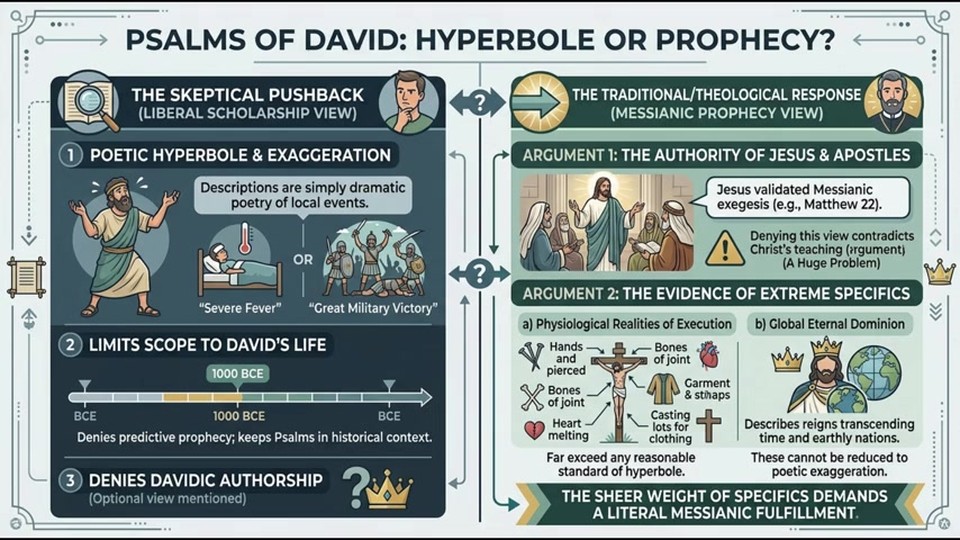
Then we put the magnifying glass on the prophetic roadmap itself:
THE CROWN — Psalm 2 and the eternal Sonship of the Messiah
THE CROSS — Psalm 22 and a medically precise account of Roman crucifixion,
written a thousand years before Rome invented it
THE EMPTY TOMB — Psalm 16 and the guarantee that He would not see corruption
THE THRONE — Psalm 110, the most quoted Old Testament chapter in the entire
New Testament, and the priest-king who bypassed the Levitical order
THE CORNERSTONE — Psalm 118, the hymn Jesus almost certainly sang hours
before Gethsemane
And we do not skip the hard parts. We sit with Psalm 88, the only lament in
the Bible that never resolves, and we face the imprecatory psalms head-on
without sanding down their edges.
Because the Psalms are the one book in Scripture that primarily teaches us
not what God says to us, but what we are permitted to say back to Him.
ESV translation throughout.
Today's Devotional
A Prayer for Peace When Life Feels Uncertain - Your Daily Prayer - November 9
When life feels uncertain, it's easy to let fear, anxiety, and endless what-ifs steal our peace.
Loading...
There is no content for this section
--- End of Results ---
Today's Devotional
A Prayer for Peace When Life Feels Uncertain - Your Daily Prayer - November 9
When life feels uncertain, it's easy to let fear, anxiety, and endless what-ifs steal our peace.


